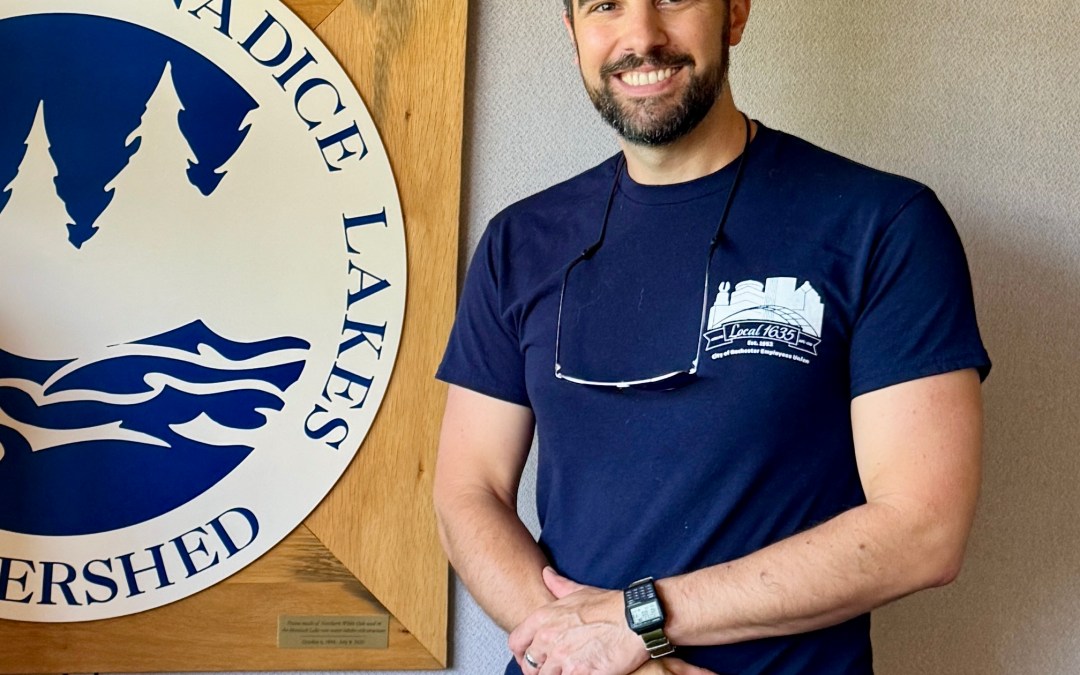
Rob Holland, local 1635 member, has always had a passion for science and emerging technologies. He majored in Biology and focused on Environmental Science in college, where he developed a strong interest in research and protecting the environment. In 2018, he saw an opportunity to apply his skills and “love for lab work” as a Water Quality Lab Assistant at the City of Rochester’s Hemlock Water Filtration Plant. After passing the Civil Service exam and completing the interview process, he was hired for the role. His dedication and performance in the lab quickly earned him a promotion to Lab Technician, a position he proudly holds today.

The City of Rochester’s primary water supply comes from Hemlock and Canadice Lakes, located about 28 miles south of Rochester in Livingston and Ontario Counties. Water from these lakes is treated at the Hemlock Water Filtration Plant and transmitted to the City through a system of tunnels, conduits, and storage reservoirs. The plant provides clean drinking water to more than 300,000 residents, serving the entire City of Rochester as well as portions of Monroe and Livingston Counties. It operates 24 hours a day, seven days a week.
Because of their vital role in supplying drinking water, Hemlock and Canadice are the only undeveloped lakes in the Finger Lakes region. Construction of the Hemlock Water Conduit System began on June 1, 1873, and less than three years later, pristine water from Hemlock Lake was flowing through the conduits into Mt. Hope Reservoir. In the early 1990’s, the City constructed a modern drinking water treatment facility that currently treats 37 million gallons of water daily. Remarkably, gravity still carries the water through those conduits and maintains water pressure in the system to today.

As a Lab Technician, Rob is responsible for maintaining the laboratory, coordinating the distribution of chemistry samples, and working directly with customers regarding water quality concerns—including lead testing. The City of Rochester has prioritized lead testing due to the serious health risks associated with lead exposure. A free lead testing program is available to all city residents, and since 2017, a grant-funded project has supported the removal of lead service lines.
According to Rob, thousands of lead pipes have already been replaced. Currently, about 16,000 service lines in the city still contain some component of lead, but the City aims to have all lead pipes removed by 2030. Rob’s work is critical to monitoring water safety as this ambitious effort continues.
Rob also serves as the City’s primary analyst for cyanotoxins— produced by harmful microorganisms commonly known as blue-green algae. With rising temperatures, the prevalence of harmful algae blooms (HABS) and their cyanotoxins has increaded worldwide. Since 2019, all toxin water testing has been conducted in-house by the City. Growing research in human health continues to underscore the harmful effects of these toxins on drinking water, highlighting the importance of Rob’s role. Rob and his colleagues play a critical role in ensuring our drinking water is safe for consumption.
Rob enjoys the variety his work offers. “On any given day I may be interfacing with the public, out on the boat collecting samples, or in the lab conducting water quality testing,” he says. This mix of fieldwork, customer interaction, and laboratory analysis keeps the role engaging and meaningful.
“It’s easy for the public to lose sight of how important this work is and that our facility is a crucial part of Monroe and Livingston Counties,” Rob explains. Security at the Hemlock Water Filtration Plant is taken very seriously, with strict measures in place to protect both the facility and the public. Oversight is extensive: the Department of Environmental Conservation (DEC), the New York State Department of Health (NYSDOH), and the Environmental Protection Agency (EPA) all monitor plant operations. “There are multiple eyes on everything we do,” Rob adds.
“We are continuously trying to maintain superior quality in everything we do because everything we do is so vitally important,” Rob emphasizes. “Everything we do has a huge impact, and we always need to consider what could go wrong and the magnitude of that impact.” The City of Rochester consistently wins awards for its water quality, a testament to the dedication of Rob and his colleagues.

In addition to his lab responsibilities, Rob serves as a union steward and participates in the hiring process for operators. During interviews, he emphasizes to candidates that this work is more than a job—it is public health. “That kind of pressure isn’t for everyone,” he notes, “but the importance of the work must always remain at the forefront of your mind.”
Rob first became involved with the union while working for Monroe County, attending meetings and contract ratifications. He quickly recognized the strength of collective action, noting that “collectively we have more power than we do apart.” He encourages fellow members to see the bigger picture, reminding them that unions serve a purpose that benefits everyone. For Rob, the union fosters inclusiveness and connection in the workplace. “Being a union steward fits a nice role where I can feel I’m making more of a difference and contributing to my future and everyone else’s,” he says.
“The less people think about us, the more it shows we’re doing our job correctly,” Rob reflects. Still, he is committed to raising awareness about the vital work happening at the Hemlock plant. He participates in community environmental fairs and encourages tour groups to consider careers in environmental stewardship—especially municipal service.
With many seasoned workers retiring and institutional knowledge being lost, Rob believes it is essential to inspire the next generation. “I want young people to know that the type of work I do provides a stable career with great benefits,” he says. “Most importantly, this work is extremely rewarding.”